TL;DR
The problem: Order seven machines and you get seven OPC UA dialects. Protocol compliance guarantees nothing about semantics – and the classic answer, connect everything and clean up in the middleware, only relocates the cost.
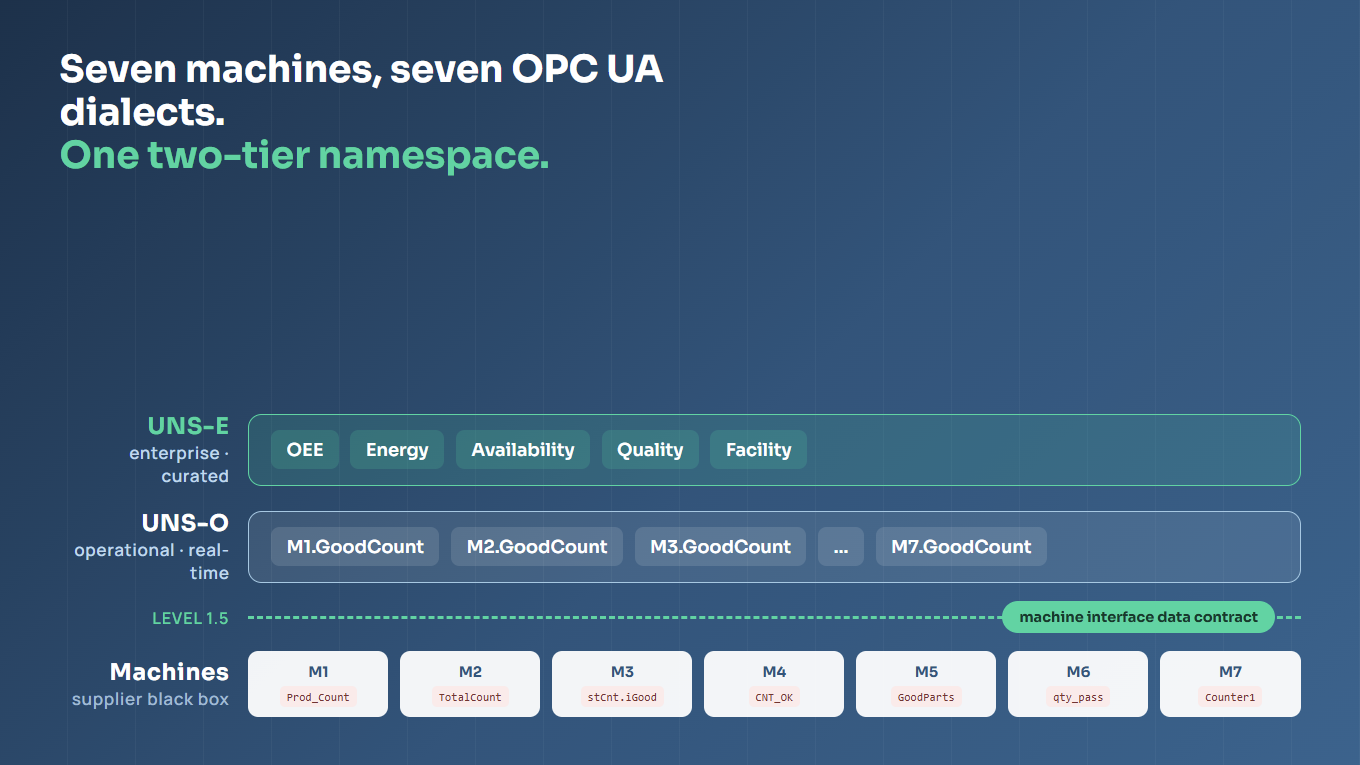
The solution: Three concepts. The machine interface data contract (level 1.5) that turns normalisation into a delivery requirement. UNS-O – the operational namespace, assembled from contracted sources. UNS-E – a governed 1:1 projection for multidisciplinary sharing.
The effect: Integration cost per new machine approaches zero, OT is never exposed unnecessarily, and production, facility and energy data share one identity backbone.
Seven Machines, Seven Dialects
Order seven machines from seven suppliers and require OPC UA on all of them. You will get it – together with seven different information models. The same physical quantity is called Prod_Count in one machine, TotalCount in the next and stCounter.iGood in the third. One reports temperature in Celsius, another in tenths of a degree as an integer. Three different state machines describe “running”, “waiting” and “fault” in three incompatible ways.
All seven are protocol compliant. None of them is comprehensible to the others. This is the core problem of industrial integration: protocol compliance guarantees nothing about semantics. And every time a new machine is purchased, you pay the interpretation work again – in integration hours, in troubleshooting, in reports that do not add up.
Why “Connect Everything” Is Not Enough
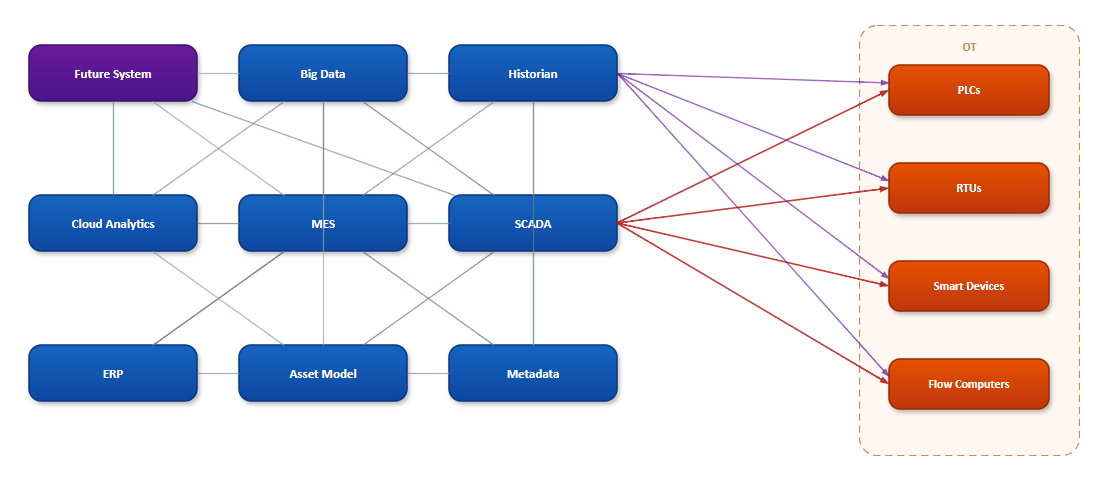
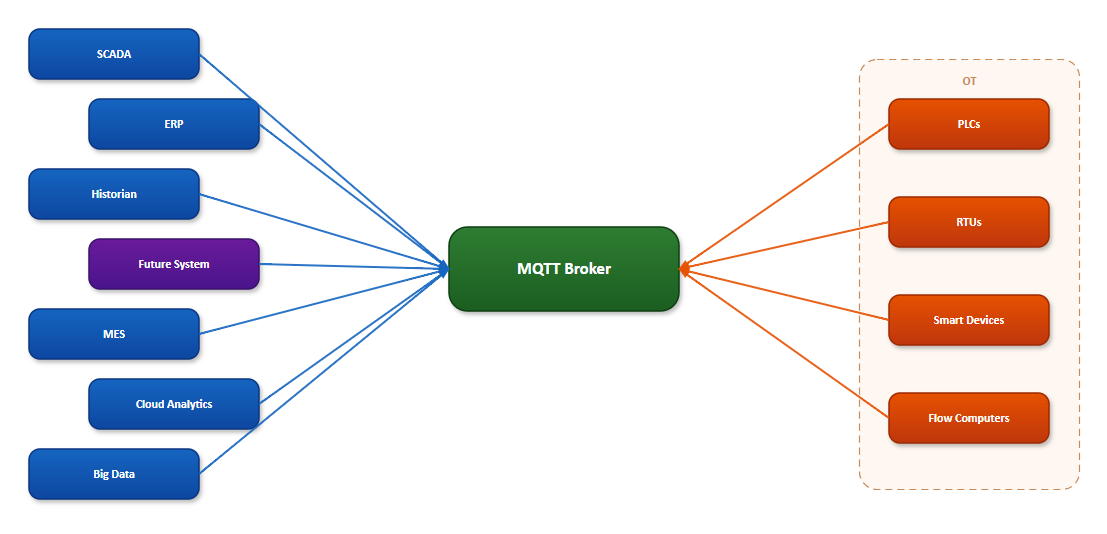
The Unified Namespace (UNS) has become industry’s answer to the integration problem: an event-driven namespace where all systems publish and consume through a common hub instead of point-to-point connections. The pattern is sound – we use it ourselves. But in its popular form it has two weaknesses.
First: most UNS initiatives connect sources as they are and contextualise in the middleware. The namespace becomes a landfill with a good search function – the cleanup cost has moved, not disappeared, and it returns with every new source. Second: a single flat namespace where “everyone sees everything” means, in practice, that the cloud can see the valve. That is unnecessary architecturally and hard to defend from an IEC 62443 perspective.
The Model: Three Concepts
1. The Machine Interface Data Contract – Level 1.5
Normalisation must happen where the buyer’s leverage is: in procurement. A machine interface data contract specifies what data the machine must expose at its boundary – identities, states, tags, units, quality flags, update rates – and the acceptance criteria tested at delivery. The machine remains the supplier’s black box below the boundary: control loops and safety are never touched. But the data interface is yours.
The pattern is proven: the Weihenstephan Standards are in effect a machine interface contract for the food industry, OMAC PackML standardises state machines, and OPC UA companion specs do the same per industry. What is new is making it the owner’s general practice – with a delivery test as the condition for approval.
2. UNS-O – The Operational Namespace
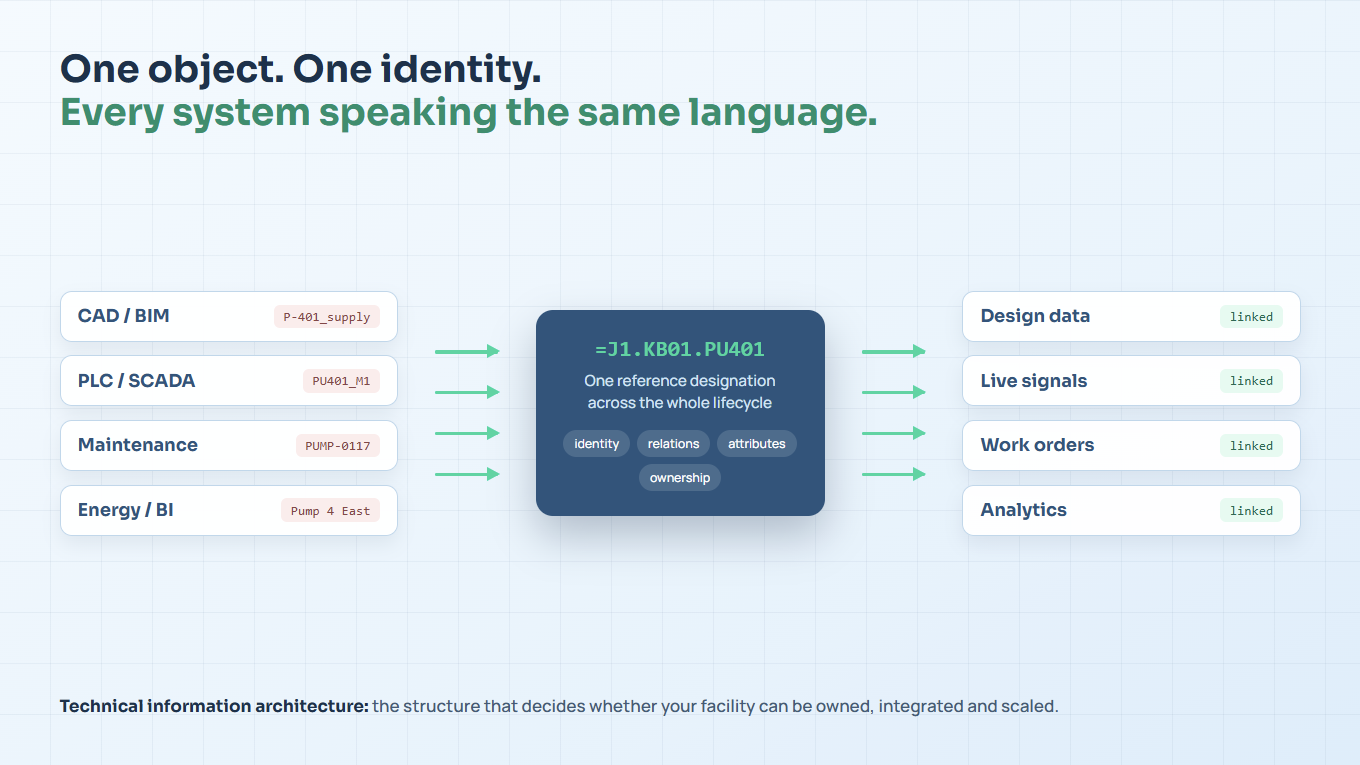
UNS-O is the facility’s real-time namespace at levels 2-3: structured along ISA-95, identified per IEC 81346, assembled from sources that already meet their contracts. There, seven machines become seven instances of one type – and machine number eight costs almost nothing to connect. The technology can be OPC UA, MQTT or both; the pattern is the same.
Crucially: domains are branches in the namespace, not architectures of their own. An air handling unit is “machine number eight” – the same contract logic applies to facility and energy as to production. Giving each discipline its own namespace would recreate the silos one level up.
3. UNS-E – The Enterprise Namespace
The enterprise level wants answers, not raw signals. UNS-E is a governed projection of UNS-O: the same objects, the same identity (1:1 through reference designations), but aggregated, schema-controlled and curated. Publication is unidirectional by default and crosses a defined zone boundary – which makes the two-tier model a security argument, not just an architectural preference.
This is where the multidisciplinary value appears: an energy analysis can connect a compressor’s consumption to both the production order and the building’s operating mode, because production, facility and energy data share one identity backbone. For facility-domain semantics, ready-made vocabularies exist in RealEstateCore and Brick Schema.
What It Takes to Hold
Identity ownership: the 1:1 mapping between the tiers is master data and needs designated ownership. Data contracts at every boundary: the machine boundary and the UNS-O/UNS-E boundary – both with schemas, units and version control, documented as data mapping. Honesty about the facility side: BMS suppliers are less used to interface contracts than machine OEMs, and BACnet semantics are weaker than OPC UA companion specs. That is not a reason to refrain – it is the reason to set the requirement.
How to Start
1. Define a canonical information model for your most common machine type. 2. Put the interface contract with acceptance criteria into your next procurement. 3. Establish the UNS-O structure (ISA-95 hierarchy, 81346 identities) with the first contracted sources. 4. Project the first curated objects into UNS-E when a real consumer exists – not before. The model is built in the order the value appears.
Need to align machine data before it becomes technical debt?
HubMind helps asset owners create machine interface data contracts, build UNS-O and design UNS-E – with identity, contracts and ownership in place from the start.