


TL;DR
Conclusion
With support for standards such as Sparkplug B, the protocol becomes the backbone of a future-proof and interoperable facility – in buildings and industry alike.
The challenge
Traditional edge handling of data often creates isolated information silos that are difficult to administer and scale.
The solution
By using MQTT as a central service (MQTT broker), a shared platform is created for all sensor data and control.
The effect
Simpler administration, improved real-time monitoring and a seamless bridge between the facility’s OT systems and IT analytics platforms.
MQTT: From Niche IoT Solution to Strategic Backbone of Modern Automation
In recent years, MQTT (Message Queuing Telemetry Transport) has evolved from a smart solution for individual IoT sensors to become one of the most important components in modern building and industrial automation. We are now seeing a clear shift in how the technology is used: from being something managed out at the “edge” of systems, MQTT is beginning to move into the very core of the facility’s IT infrastructure.
The Power of Lightning-Fast Deployment
When discussing the advantages of MQTT, we often end up in technical details, but we frequently forget the purely commercial gain: speed. Thanks to modern brokers such as EMQX, we have seen how you can go from drawing board to a fully functional infrastructure for an entire factory in record time.
In traditional systems, it often takes weeks or months to configure each individual node and ensure they communicate with each other. With a cloud-based or clustered MQTT solution, we are talking about minutes to set up the hub itself. For a facility owner or industrial manager, this means you can scale up from a pilot in a small plant room to covering an entire property portfolio or production line without having to rebuild the architecture from scratch.
The Problem of the Fragmented Facility
Traditionally, both building and industrial automation have been built in closed verticals. Each system – cooling, heating, lighting, production lines – has often had its own logic and its own proprietary protocols. The result has been an unmanageable tangle of integrations where data lives in isolated silos.
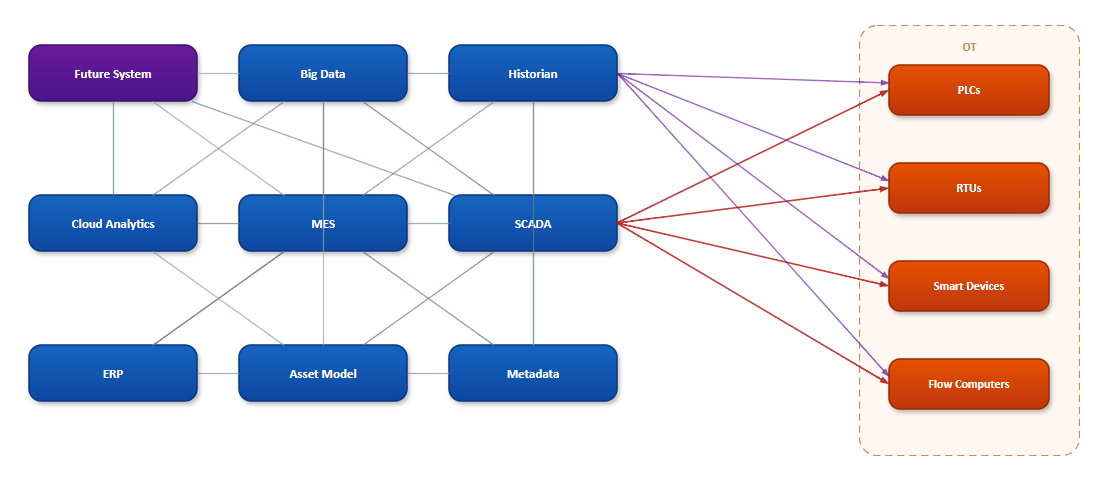
By elevating MQTT to a central service, we change the game. Instead of each device sending data to a local node that may then communicate with the cloud, we create a shared information bus. Here the MQTT broker becomes the central hub where all communication meets. This provides unmatched scalability: once the infrastructure is in place, it does not matter whether you add ten or ten thousand new sensors – the architecture remains the same.
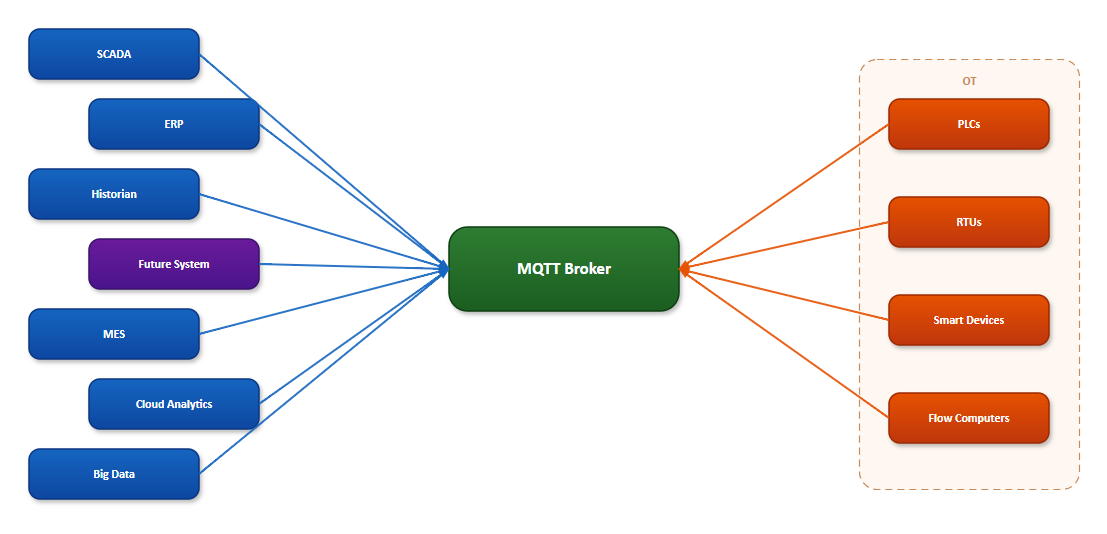
Real IT/OT Convergence
One of the greatest gains from a centralised MQTT service is that we finally begin to speak a language that the IT department understands and accepts. Historically, the gap between operational technology (OT) and IT has been large, but MQTT’s lightweight nature and its ability to easily integrate with modern analytics tools and business systems (ERP, MES) bridges this gap.
When data flows centrally through a broker, it suddenly becomes available to the entire organisation. The facility owner can leverage real-time data for predictive maintenance, while the finance department can get exact energy consumption figures directly into their systems. We are now seeing solutions that handle over 100 million simultaneous connections – a level of future-proofing that traditional BMS systems have never come close to.
The Challenges We Cannot Ignore
But centralisation also comes with greater responsibility. When MQTT is made the heart of the facility’s operations, entirely different demands are placed on network robustness. We leave the “playground” stage and enter critical infrastructure:
- Security as a foundation: Simple passwords are no longer sufficient. A centralised environment requires a well-thought-out security strategy with TLS encryption and certificate management (CA). Every device that connects must be who it claims to be.
- Redundancy and reliability: If the central broker goes down, the facility must not stop functioning. Therefore we increasingly see implementations with clustered brokers and advanced failover mechanisms, built to withstand outages without losing critical data.
- Structure through Sparkplug: A common pitfall with MQTT is that data becomes unstructured – values are sent without context. Sparkplug B addresses this by ensuring all devices in the network understand each other’s data directly, a prerequisite for true interoperability.
Future Outlook
We are moving away from the era of buying “finished packages” where hardware and software are locked together. Tomorrow’s BMS and SCADA are software-defined, flexible and data-centred. By investing in a robust, centralised MQTT infrastructure, you lay the foundation for a facility that is not only smart today, but ready for technologies we have not yet even glimpsed.
MQTT is no longer just a protocol for small sensors – it is the foundation for how we will manage and optimise our buildings and production facilities for decades to come.
Getting started with MQTT – four steps
- Take inventory: Map which systems and devices already speak MQTT – and which need a gateway.
- Define the structure: Decide topic structure and naming convention before the first device connects – not after.
- Secure the foundation: TLS encryption, certificate management and access control from day one.
- Start small, scale smart: Pilot in a bounded part of the facility – the architecture then scales without rebuilding.
Are you ready to make MQTT the hub of your system?
Moving from local edge solutions to a centralised MQTT infrastructure requires the right planning around security, redundancy and network capacity. We help you navigate from strategy to operational solution.
Continue reading
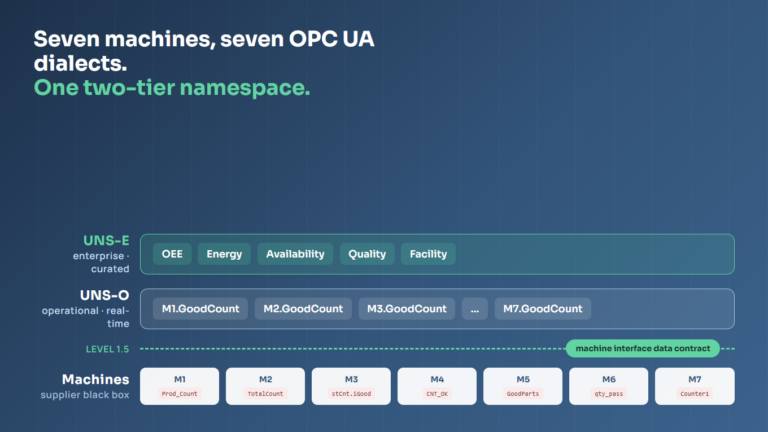
Seven Machines, Seven OPC UA Dialects: Why Complex Operations Need a Two-Tier UNS
A durable two-tier UNS needs machine interface data contracts, a canonical operational namespace, curated enterprise information and explicit ownership.
Read article
Brick: The Semantic Interface
Turn a Brick graph into a governed semantic interface using SPARQL discovery, external data references, SHACL validation, versioning, provenance and acceptance tests.
Read article
Multidisciplinary Digitalisation: From Silos to Collaboration
Multidisciplinary digitalisation succeeds when business, OT and IT make shared decisions and the owner side takes responsibility for interfaces.
Read article
Leave a Reply