Category: Automation & Control Systems

Artiklar om automation, styrsystem, SCADA och BMS. Hubmind delar erfarenheter om hur automationslösningar byggs hållbart och förvaltas över tid.

  • Seven Machines, Seven OPC UA Dialects: Why Complex Operations Need a Two-Tier UNS

    Seven Machines, Seven OPC UA Dialects: Why Complex Operations Need a Two-Tier UNS

    TL;DR

    The problem: Order seven machines and you get seven OPC UA dialects. Protocol compliance guarantees nothing about semantics – and the classic answer, connect everything and clean up in the middleware, only relocates the cost.

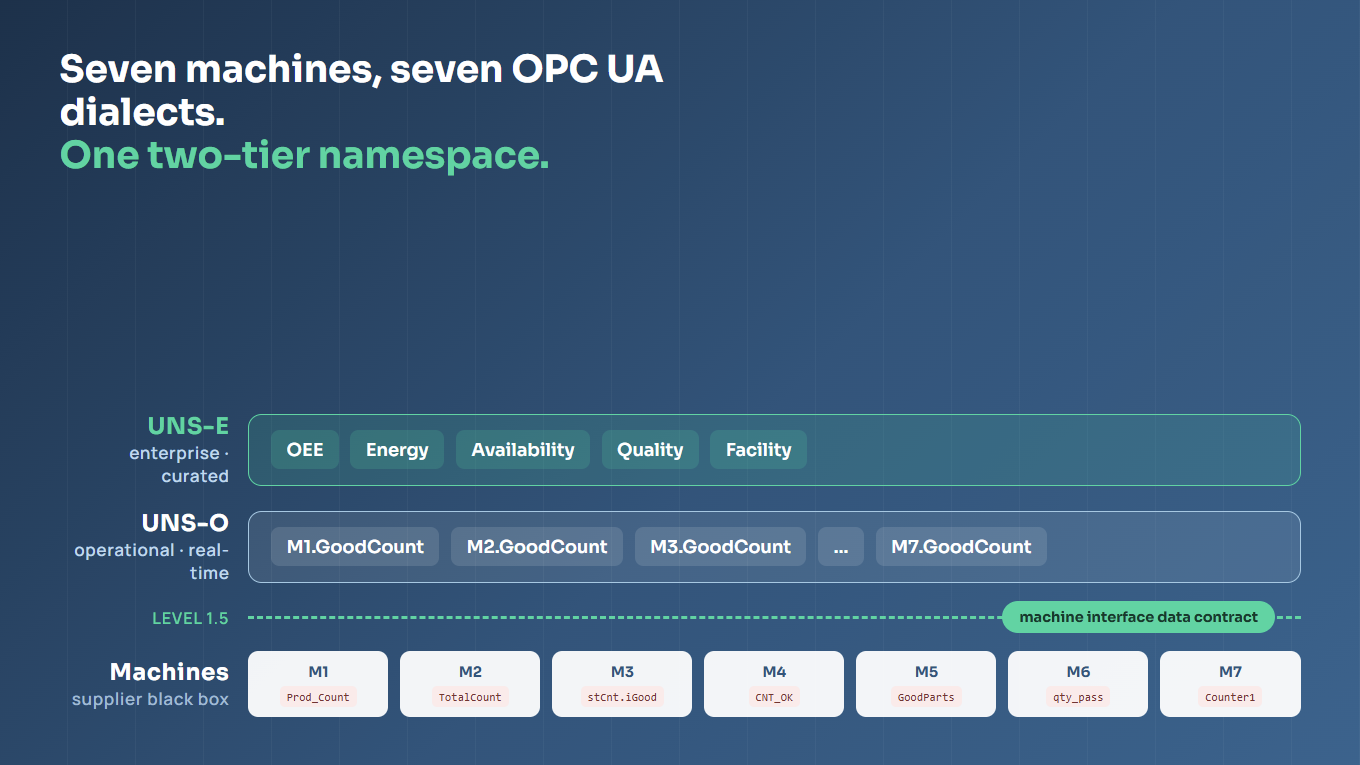
    The solution: Three concepts. The machine interface data contract (level 1.5) that turns normalisation into a delivery requirement. UNS-O – the operational namespace, assembled from contracted sources. UNS-E – a governed 1:1 projection for multidisciplinary sharing.

    The effect: Integration cost per new machine approaches zero, OT is never exposed unnecessarily, and production, facility and energy data share one identity backbone.

    Seven Machines, Seven Dialects

    Order seven machines from seven suppliers and require OPC UA on all of them. You will get it – together with seven different information models. The same physical quantity is called Prod_Count in one machine, TotalCount in the next and stCounter.iGood in the third. One reports temperature in Celsius, another in tenths of a degree as an integer. Three different state machines describe “running”, “waiting” and “fault” in three incompatible ways.

    All seven are protocol compliant. None of them is comprehensible to the others. This is the core problem of industrial integration: protocol compliance guarantees nothing about semantics. And every time a new machine is purchased, you pay the interpretation work again – in integration hours, in troubleshooting, in reports that do not add up.

    Why “Connect Everything” Is Not Enough

    The Unified Namespace (UNS) has become industry’s answer to the integration problem: an event-driven namespace where all systems publish and consume through a common hub instead of point-to-point connections. The pattern is sound – we use it ourselves. But in its popular form it has two weaknesses.

    First: most UNS initiatives connect sources as they are and contextualise in the middleware. The namespace becomes a landfill with a good search function – the cleanup cost has moved, not disappeared, and it returns with every new source. Second: a single flat namespace where “everyone sees everything” means, in practice, that the cloud can see the valve. That is unnecessary architecturally and hard to defend from an IEC 62443 perspective.

    The Model: Three Concepts

    1. The Machine Interface Data Contract – Level 1.5

    Normalisation must happen where the buyer’s leverage is: in procurement. A machine interface data contract specifies what data the machine must expose at its boundary – identities, states, tags, units, quality flags, update rates – and the acceptance criteria tested at delivery. The machine remains the supplier’s black box below the boundary: control loops and safety are never touched. But the data interface is yours.

    The pattern is proven: the Weihenstephan Standards are in effect a machine interface contract for the food industry, OMAC PackML standardises state machines, and OPC UA companion specs do the same per industry. What is new is making it the owner’s general practice – with a delivery test as the condition for approval.

    2. UNS-O – The Operational Namespace

    UNS-O is the facility’s real-time namespace at levels 2-3: structured along ISA-95, identified per IEC 81346, assembled from sources that already meet their contracts. There, seven machines become seven instances of one type – and machine number eight costs almost nothing to connect. The technology can be OPC UA, MQTT or both; the pattern is the same.

    Crucially: domains are branches in the namespace, not architectures of their own. An air handling unit is “machine number eight” – the same contract logic applies to facility and energy as to production. Giving each discipline its own namespace would recreate the silos one level up.

    3. UNS-E – The Enterprise Namespace

    The enterprise level wants answers, not raw signals. UNS-E is a governed projection of UNS-O: the same objects, the same identity (1:1 through reference designations), but aggregated, schema-controlled and curated. Publication is unidirectional by default and crosses a defined zone boundary – which makes the two-tier model a security argument, not just an architectural preference.

    This is where the multidisciplinary value appears: an energy analysis can connect a compressor’s consumption to both the production order and the building’s operating mode, because production, facility and energy data share one identity backbone. For facility-domain semantics, ready-made vocabularies exist in RealEstateCore and Brick Schema.

    What It Takes to Hold

    Identity ownership: the 1:1 mapping between the tiers is master data and needs designated ownership. Data contracts at every boundary: the machine boundary and the UNS-O/UNS-E boundary – both with schemas, units and version control, documented as data mapping. Honesty about the facility side: BMS suppliers are less used to interface contracts than machine OEMs, and BACnet semantics are weaker than OPC UA companion specs. That is not a reason to refrain – it is the reason to set the requirement.

    How to Start

    1. Define a canonical information model for your most common machine type. 2. Put the interface contract with acceptance criteria into your next procurement. 3. Establish the UNS-O structure (ISA-95 hierarchy, 81346 identities) with the first contracted sources. 4. Project the first curated objects into UNS-E when a real consumer exists – not before. The model is built in the order the value appears.

    Need to align machine data before it becomes technical debt?

    HubMind helps asset owners create machine interface data contracts, build UNS-O and design UNS-E – with identity, contracts and ownership in place from the start.

  • MQTT: From Edge Functionality to Central Service

    MQTT: From Edge Functionality to Central Service

    TL;DR

    Conclusion

    With support for standards such as Sparkplug B, the protocol becomes the backbone of a future-proof and interoperable facility – in buildings and industry alike.

    The challenge

    Traditional edge handling of data often creates isolated information silos that are difficult to administer and scale.

    The solution

    By using MQTT as a central service (MQTT broker), a shared platform is created for all sensor data and control.

    The effect

    Simpler administration, improved real-time monitoring and a seamless bridge between the facility’s OT systems and IT analytics platforms.

    MQTT: From Niche IoT Solution to Strategic Backbone of Modern Automation

    In recent years, MQTT (Message Queuing Telemetry Transport) has evolved from a smart solution for individual IoT sensors to become one of the most important components in modern building and industrial automation. We are now seeing a clear shift in how the technology is used: from being something managed out at the “edge” of systems, MQTT is beginning to move into the very core of the facility’s IT infrastructure.

    The Power of Lightning-Fast Deployment

    When discussing the advantages of MQTT, we often end up in technical details, but we frequently forget the purely commercial gain: speed. Thanks to modern brokers such as EMQX, we have seen how you can go from drawing board to a fully functional infrastructure for an entire factory in record time.

    In traditional systems, it often takes weeks or months to configure each individual node and ensure they communicate with each other. With a cloud-based or clustered MQTT solution, we are talking about minutes to set up the hub itself. For a facility owner or industrial manager, this means you can scale up from a pilot in a small plant room to covering an entire property portfolio or production line without having to rebuild the architecture from scratch.

    The Problem of the Fragmented Facility

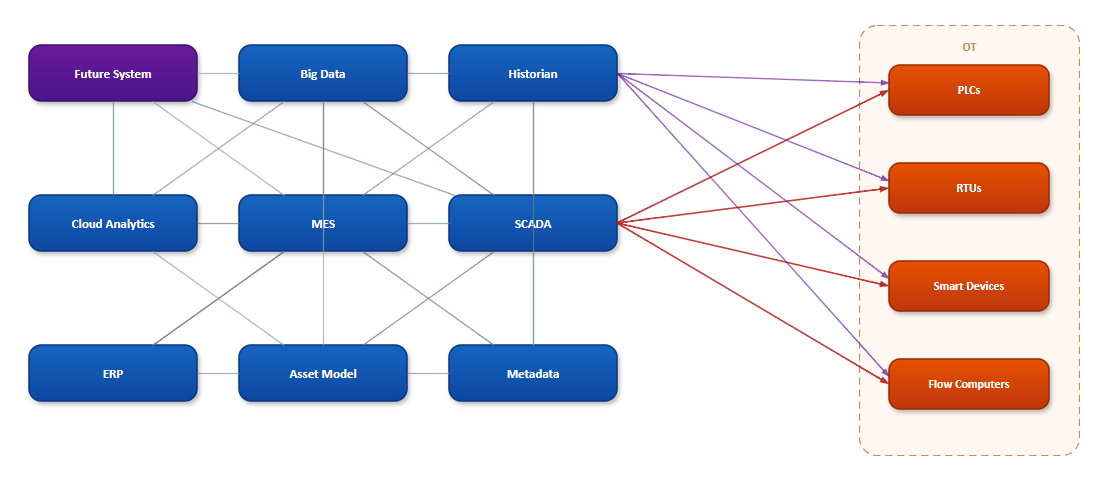
    Traditionally, both building and industrial automation have been built in closed verticals. Each system – cooling, heating, lighting, production lines – has often had its own logic and its own proprietary protocols. The result has been an unmanageable tangle of integrations where data lives in isolated silos.

    Traditional architecture: point-to-point integrations
    Today: every system is integrated point-to-point. Complexity grows exponentially with each new system.

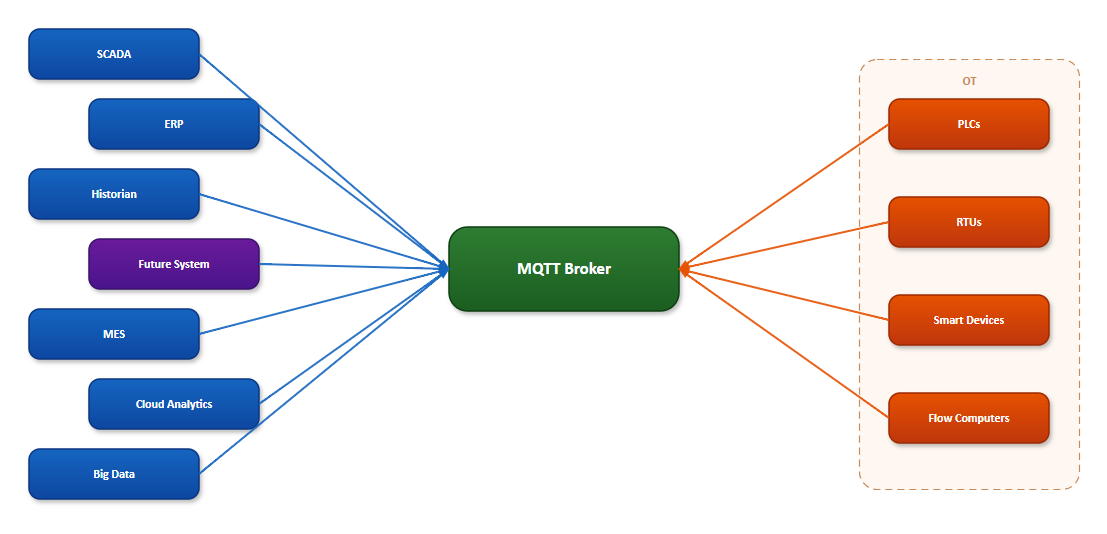
    By elevating MQTT to a central service, we change the game. Instead of each device sending data to a local node that may then communicate with the cloud, we create a shared information bus. Here the MQTT broker becomes the central hub where all communication meets. This provides unmatched scalability: once the infrastructure is in place, it does not matter whether you add ten or ten thousand new sensors – the architecture remains the same.

    With a central MQTT broker: hub and spoke
    With a central MQTT broker: every system connects once. The architecture stays the same regardless of scale.

    Real IT/OT Convergence

    One of the greatest gains from a centralised MQTT service is that we finally begin to speak a language that the IT department understands and accepts. Historically, the gap between operational technology (OT) and IT has been large, but MQTT’s lightweight nature and its ability to easily integrate with modern analytics tools and business systems (ERP, MES) bridges this gap.

    When data flows centrally through a broker, it suddenly becomes available to the entire organisation. The facility owner can leverage real-time data for predictive maintenance, while the finance department can get exact energy consumption figures directly into their systems. We are now seeing solutions that handle over 100 million simultaneous connections – a level of future-proofing that traditional BMS systems have never come close to.

    The Challenges We Cannot Ignore

    But centralisation also comes with greater responsibility. When MQTT is made the heart of the facility’s operations, entirely different demands are placed on network robustness. We leave the “playground” stage and enter critical infrastructure:

    • Security as a foundation: Simple passwords are no longer sufficient. A centralised environment requires a well-thought-out security strategy with TLS encryption and certificate management (CA). Every device that connects must be who it claims to be.
    • Redundancy and reliability: If the central broker goes down, the facility must not stop functioning. Therefore we increasingly see implementations with clustered brokers and advanced failover mechanisms, built to withstand outages without losing critical data.
    • Structure through Sparkplug: A common pitfall with MQTT is that data becomes unstructured – values are sent without context. Sparkplug B addresses this by ensuring all devices in the network understand each other’s data directly, a prerequisite for true interoperability.

    Future Outlook

    We are moving away from the era of buying “finished packages” where hardware and software are locked together. Tomorrow’s BMS and SCADA are software-defined, flexible and data-centred. By investing in a robust, centralised MQTT infrastructure, you lay the foundation for a facility that is not only smart today, but ready for technologies we have not yet even glimpsed.

    MQTT is no longer just a protocol for small sensors – it is the foundation for how we will manage and optimise our buildings and production facilities for decades to come.

    Getting started with MQTT – four steps

    1. Take inventory: Map which systems and devices already speak MQTT – and which need a gateway.
    2. Define the structure: Decide topic structure and naming convention before the first device connects – not after.
    3. Secure the foundation: TLS encryption, certificate management and access control from day one.
    4. Start small, scale smart: Pilot in a bounded part of the facility – the architecture then scales without rebuilding.

    Are you ready to make MQTT the hub of your system?

    Moving from local edge solutions to a centralised MQTT infrastructure requires the right planning around security, redundancy and network capacity. We help you navigate from strategy to operational solution.

  • When IT Manages OT

    When IT Manages OT

    TL;DR

    Conclusion

    Successful integration is more about trust and clear processes than just network cables.

    The challenge

    IT and OT have different priorities; IT focuses on data security and confidentiality, while OT prioritises real-time operations and availability.

    The solution

    A clear boundary definition and a shared governance model that respects both disciplines’ needs.

    The effect

    A secure and stable environment where control systems are protected by IT standards without risking the operation of the facility.

    Organisation, Competence and Responsibility in Tomorrow’s OT Environments

    As automation systems become IP-based, it is not only the technical architecture that changes, but also the organisation’s allocation of responsibility. BMS systems increasingly use the same networks, the same security mechanisms and the same infrastructure as enterprise IT. The IT organisation thus becomes a direct prerequisite for building automation to function – regardless of whether this is formally stated or not.

    This is fundamentally a management and governance question, not a technical detail.

    From Enterprise IT to a Shared Platform

    Traditionally, the IT department’s remit has been clearly tied to enterprise IT: users, clients, servers, applications and networks for office and business systems. Building automation and BMS have often been managed by facility management, operations teams or external suppliers, with their own systems and working methods.

    When BMS becomes IP-based, this boundary is erased. The IT infrastructure becomes the shared platform for OT systems as well. This means decisions about networks, addressing, security and changes directly affect the building’s function. In practice, IT is already involved in OT operations – even if the organisation is not always structured for it.

    Different Logics – IT and OT Have Different Prerequisites

    A fundamental challenge is that IT and OT have historically been governed by different logics.

    IT environments are often characterised by: frequent updates, standardised platforms, acceptance of planned outages, and focus on security updates and lifecycle management.

    OT environments, by contrast, are characterised by: long lifespans, high requirements for continuous operation, limited tolerance for change, and systems directly linked to physical function.

    When these perspectives meet without adaptation, friction arises. Operational disruptions, ambiguous decisions and gaps in responsibility are often organisational problems rather than technical ones.

    Patching and Change – An Organisational Key Issue

    One of the clearest areas where IT and OT logic differ is patching and change management. In IT, regular patching is a natural part of security work. In OT, the same update can mean risk of downtime, unforeseen side effects or compatibility problems. An outage in a BMS system affects not only IT functions, but also comfort, energy consumption and sometimes safety functions in the building.

    When OT systems are on the same network and managed through the same processes as IT, adapted procedures are therefore required:

    • Separate change windows for OT
    • Requirements for testing before updates
    • Clear coordination with OT managers before changes to infrastructure

    This is fundamentally a management and governance question, not a technical detail.

    Competence – Mutual Understanding Rather Than Dual Expertise

    A common mistake is trying to create roles that must fully master both deep IT competence and deep OT competence. In practice this is difficult to maintain and often leads to dependencies on individuals. A more sustainable strategy is to build mutual understanding:

    • IT needs to understand OT systems’ requirements for stability, lifespan and consequences of outages
    • OT needs to understand IP networks, addressing, certificates, segmentation and security principles
    • Specialist competence remains within each area, but with clear interfaces for collaboration

    Organisational Models That Work in Practice

    Organisations that succeed with IT/OT convergence often have a clear allocation of responsibility. IT is responsible for the platform: network infrastructure, IP addressing, DNS and DHCP, basic cybersecurity, certificate management and segmentation. OT is responsible for the systems: BMS function and logic, availability and performance requirements, validation of changes from an operations perspective. Shared responsibility covers: change management, incident management, documentation and lifecycle management.

    The decisive factor is not exactly how the organisation is structured, but that responsibilities and decision paths are clear.

    Common Mistakes

    • Moving OT to IT without changing working methods – IT applies existing processes without regard for OT systems’ operational reliability requirements
    • Unclear responsibility between IT and OT – Nobody owns the whole picture, leading to decision gaps and delays
    • Changes implemented without OT alignment – Technically correct changes have unwanted operational consequences
    • Overconfidence in hybrid roles – Individuals are expected to cover the entire competence spectrum without organisational support
    • Treating IT/OT convergence as a technology project – Organisational questions, training and governance are deprioritised

    Who bears responsibility when the building goes digital?

    When the IT department gets responsibility for the building’s OT environment, new challenges arise around security, lifecycles and operational responsibility. We help you define the processes and requirements that make the handover and daily management a success rather than a source of conflict.

  • Tomorrow’s BMS Requires IT-Ready Networks

    Tomorrow’s BMS Requires IT-Ready Networks

    TL;DR

    Conclusion

    The network is not just a cable – it is the backbone of your digital facility strategy.

    The challenge

    Traditional BMS networks are often isolated and lack the security and bandwidth required for modern digitalisation.

    The solution

    By building an IT-ready infrastructure with clear segmentation, a stable platform is created for tomorrow’s control systems.

    The effect

    Enables secure system integration, remote control and real-time analytics without compromising operational security.

    Modern IP Infrastructure for Commercial Properties – The Foundation for Tomorrow’s BMS

    Building automation has long been built on traditional fieldbus protocols such as Modbus, M-Bus and similar technologies. These systems have been robust and relatively easy to maintain, but have been limited in terms of integration, scalability and access to data outside the system itself.

    A modern BMS system is no longer an isolated technical system. It is a network-dependent platform that requires the same structural care as other critical IT infrastructure.

    With the transition to IP-based BMS systems, the conditions change fundamentally. Communication takes place over Ethernet, often with standardised protocols, and systems become part of the organisation’s overall IT environment. This opens up new possibilities in analytics, optimisation and integration – but also places clear demands on network design, security and operating principles.

    A modern BMS system is no longer an isolated technical system. It is a network-dependent platform that requires the same structural care as other critical IT infrastructure.

    IP-Based vs Proprietary Networks

    Traditional automation systems are often built on specialised networks and protocols adapted for a specific purpose. IP-based Ethernet instead means: individual addressing of every device (e.g. with IPv6), better support for integration between different systems and suppliers, and use of standardised protocols with broad market acceptance and long lifespans.

    When BMS communicates over IP, the system ceases to be technically isolated. It becomes part of the shared network infrastructure and is directly affected by how that network is designed, monitored and managed.

    DNS and DHCP – More Than Supporting Functions

    In IP-based automation environments, DNS and DHCP are no longer peripheral support services. They form a central part of the infrastructure: managing large volumes of connected devices, creating a readable, traceable and structured address environment, and enabling automatic updates of names and addresses via dynamic DNS.

    Without a well-thought-out strategy for DNS and DHCP, the environment quickly becomes difficult to oversee. With standardised naming conventions, DNS can also be used as an active tool for documentation and structure, where names reflect function, system membership and location.

    Secure Infrastructure – Encryption, Certificates and Segmentation

    When BMS devices connect to the IP network, the attack surface increases. Systems that were previously physically or logically isolated are now accessible via the network, requiring an entirely different security mindset. Fundamental principles for a secure BMS infrastructure include:

    • Network segmentation, separating automation from other IT traffic
    • Encryption of data in transit, e.g. with TLS
    • Central certificate management, rather than local manual solutions

    Security in OT environments cannot be reduced to individual firewall rules. It must be built into the network architecture from the start and take into account both the threat landscape and operational safety.

    Technical Maturity – Standards, Tools and Processes

    IP-based building automation requires greater technical maturity than traditional solutions. A modern BMS environment needs, among other things: standardised communication protocols such as OPC UA or MQTT, monitoring and visibility of both network and systems, and continuous risk assessment linked to changes and updates.

    Established IT principles such as defence-in-depth and zero trust must be applied with an understanding of the OT environment’s requirements. Security and stability must be balanced, not set against each other.

    Common Mistakes

    • Assuming office IT principles work unchanged in OT environments – Automatic patches and rapid changes can have direct operational consequences in BMS systems
    • Underestimating the need for network segmentation – Inadequate separation increases both security risks and the risk of unintentional impact
    • Lacking a clear strategy for addressing and DNS before implementation – Unstructured solutions lead to increased operating costs and difficult fault-finding
    • Treating OT security as purely a firewall question – Without a holistic view of certificates, encryption and zone division, protection becomes fragmented

    Is your BMS network ready for the next step?

    A modern control system is only as strong as the network it communicates on. We help you bridge the gap between traditional building technology and modern IT architecture – from requirements specification to operational network.

Contact us