


Technical information architecture · Authority and boundaries
The complete object has no single owner.
BIM, engineering, automation, IT and asset management can each be excellent within their domain. The foundation fails when one discipline mistakes a powerful representation for authority over the complete technical object.
TL;DR
Expertise has a boundary.
Authority needs a mandate.
A complete technical object is a federation of governed truths, not the contents of one model, platform or discipline.
- The owner must declare which domain controls each kind of fact.
- Contributing information is not the same as approving it.
- Coordination gives visibility across boundaries; it does not automatically grant authority across them.
- A strong specialist states both what they know and where another authority must decide.
- The dangerous role is not the narrow expert. It is the role whose claimed mandate grows faster than its competence, evidence and accountability.
BIM is exceptionally powerful. That is exactly why its boundary matters.
BIM teams can be among the strongest information practitioners in a project. They understand model federation, spatial coordination, object properties, information deliveries and the practical reality of getting many disciplines into a shared environment.
That competence creates enormous value. It does not automatically make BIM the authority for process function, automation semantics, maintainable asset identity, cybersecurity, operating state or owner acceptance.
The risk appears when the most visible model is mistaken for the complete object. A coordinated geometric representation begins to absorb requirements, asset records, control signals and lifecycle decisions simply because the platform can store them.
- Accepted geometry, placement and spatial composition
- Model federation and geometric clash coordination
- Representation requirements and model-delivery checks
- Traceable links from model objects to other authorities
- Functional intent and cross-system architecture
- Control behaviour, signals and operational semantics
- The permanent asset record and maintenance lifecycle
- Security risk, owner acceptance or enterprise identity
Same principle · four boundaries
Lead your domain. Hand off the next decision.
A clear mandate names both the work a domain should lead and the truth it must not redefine.
Build the complete-object house.
Select a role or information brick. The detail panel shows what that authority controls, where its truth lives, who contributes and where its mandate stops.
Give every authority a job and a stop line.
The exact organisation varies, but the control logic should not. For every important fact, name one primary authority, the contributors it needs and the decisions it must not make alone.
| Domain | Should control | Should contribute | Should not own alone |
|---|---|---|---|
| Owner governance | Identity rules, requirements, acceptance, provenance | Every lifecycle domain | Detailed discipline design or platform operation |
| Systems engineering | Function, interfaces, technical intent, system boundaries | Operations, BIM, OT, IT, suppliers | Installed history or current operational state |
| BIM / spatial | Geometry, placement, spatial representation, model coordination | Engineering, suppliers, survey, asset information | Complete-object identity, control semantics or maintenance truth |
| Asset management | Installed asset master, maintenance and replacement history | Commissioning, suppliers, operations | Design intent, geometry or high-frequency observations |
| OT / automation | Executable control configuration, signals, alarms, runtime state | Engineering, operations, security, OEMs | Contractual requirements or long-term enterprise semantics |
| IT / integration | Federation, access, platform availability, validation services | Every authoritative domain | The domain meaning of the information being transported |
| Security | Risk decisions, protection requirements, continuity objectives | Owner, IT, OT, engineering, operations | Engineering function or operational process ownership |
A tool is never an authority by itself. Revit, an IFC repository, a CDE, Maximo, an OPC UA server, a data platform and a digital twin can all hold important records. Authority comes from the owner’s operating model: mandate, competence, source, approval and consequences.
Mandate inflation often looks like helpfulness.
Overreach rarely announces itself as overreach. It arrives as efficiency: “We already have the model,” “the platform can store it,” or “someone needs to decide.” The short-term gap is closed. A weak foundation is embedded.
The most dangerous specialist is not the one who knows too little. It is the one whose authority expands faster than their awareness of what they do not know.
This standard must also apply to the owner, the architect and the systems engineer. Cross-disciplinary responsibility does not mean pretending to possess every discipline’s depth. It means recognising the right authority, forcing boundary decisions into the open and refusing unsupported certainty.
Govern the handoffs, not just the boxes.
A role chart is not enough. The owner needs a decision chain for every critical information class, especially where several domains contribute to the same object.
For critical objects, an authority register should state at minimum: information class, primary authority, contributors, authoritative source, validation rule, approval role, effective lifecycle stage and escalation path.
The house is not strongest when one discipline owns every brick. It is strongest when each brick is controlled by the right authority and every interface has a named decision owner.
The core principle
Competence builds the bricks.
Governance carries the load.
A complete technical object is not one perfect model. It is a governed assembly of requirements, technical intent, representation, installed records, operational truth, protection and evidence.
Know your domain. Declare your boundary. Link the whole.Continue reading
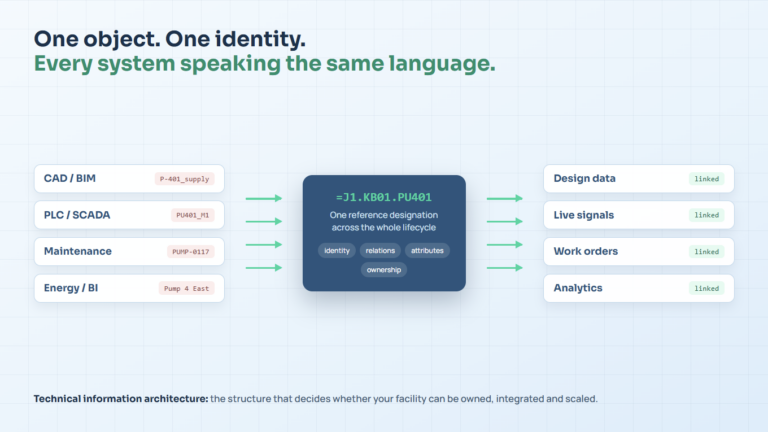
Why Technical Information Architecture Matters in Complex Technical Environments
Technical information architecture gives objects stable identity and traceability across requirements, systems, signals, documents, maintenance and analytics.
Read article
Technical Debt in Technical Facilities: The Hidden Cost of Digitalisation
Technical debt becomes governable when every shortcut is connected to recurring interest, a risk trigger, an accountable owner and a repayment plan.
Read article
Brick: The Semantic Interface
Turn a Brick graph into a governed semantic interface using SPARQL discovery, external data references, SHACL validation, versioning, provenance and acceptance tests.
Read article