

Information modelling
Articles on information models, metadata, semantics and the structures that make technical data understandable and reusable.
-

The Complete Object: Who Owns Which Truth?
A practical owner-side guide to technical information authority: who contributes, governs and assures each part of a complete technical object.
-

Brick: The Semantic Interface
Turn a Brick graph into a governed semantic interface using SPARQL discovery, external data references, SHACL validation, versioning, provenance and acceptance tests.
-
Brick: One Object, a Graph of Context
Build a useful Brick subgraph around AHU-3 using classes, instances, composition, topology, location, points, controls and governed graph boundaries.
-

Brick: From Tags to Meaning
Learn how Brick turns building-system tags into machine-readable entities, classes and relationships, and why it complements IEC 81346.
-
IEC 81346, ISA-95 and Brick: Give Every Model the Right Job
Learn how IEC 81346, ISA-95, Brick and CMMS/EAM answer different questions about the same technical object, and how canonical identity connects them.
-
IEC 81346 Explained: Structure Before Naming
IEC 81346 is more than a naming standard. Learn how shared structure gives technical objects stable identity across disciplines and the facility lifecycle.
-
IEC 81346 Aspects: One Object, Several Views
See how one technical object can have function, product, installation and type designations under IEC 81346 without becoming several unrelated objects.
-
Implementing IEC 81346: From Notation to Infrastructure
How asset owners can implement IEC 81346 as governed information infrastructure across procurement, BIM, automation, EAM and operations.
-
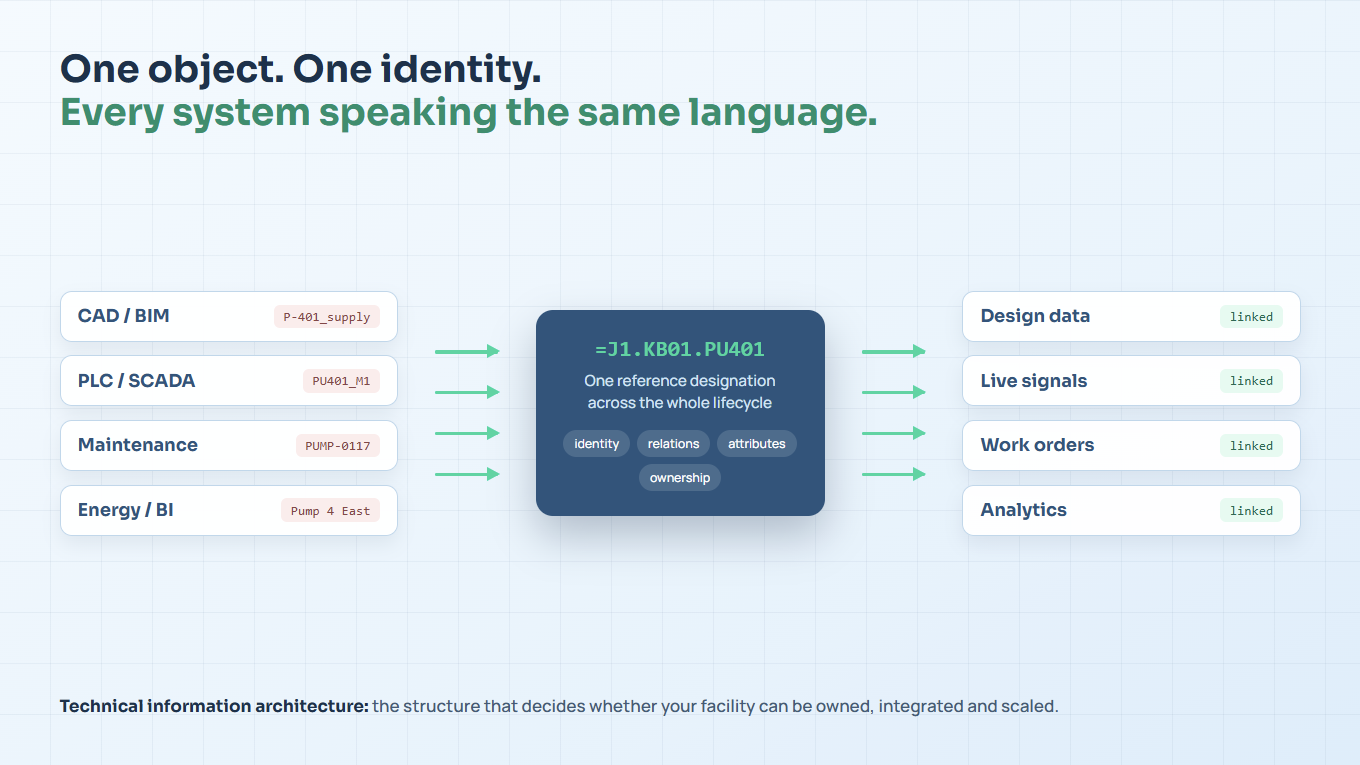
Why Technical Information Architecture Matters in Complex Technical Environments
Technical information architecture gives objects stable identity and traceability across requirements, systems, signals, documents, maintenance and analytics.
-

Weihenstephan Standards: The Common Language for Food and Beverage Producers
Weihenstephan Standards give food producers a shared machine language when states, counters, semantics, data quality and acceptance tests are specified.