

TL;DR
The challenge: Complex facilities are not only built from systems and equipment. They are built from information. When objects, signals, requirements, documents and responsibilities drift apart, technical debt is created before the facility is even in operation.
The solution: A coherent technical information architecture, where data mapping, information modelling, master data ownership and data governance define how information is created, owned and moved between systems.
The effect: Traceability across systems, clear ownership, and a facility that can be integrated, maintained and developed throughout its lifecycle.
The Problem Is Not Lack of Data
Modern industrial and facility projects are becoming increasingly digital, connected and supplier-driven. Automation systems, building systems, production equipment, IT/OT networks, BIM models, SCADA platforms, data platforms and maintenance systems all create and consume technical information.
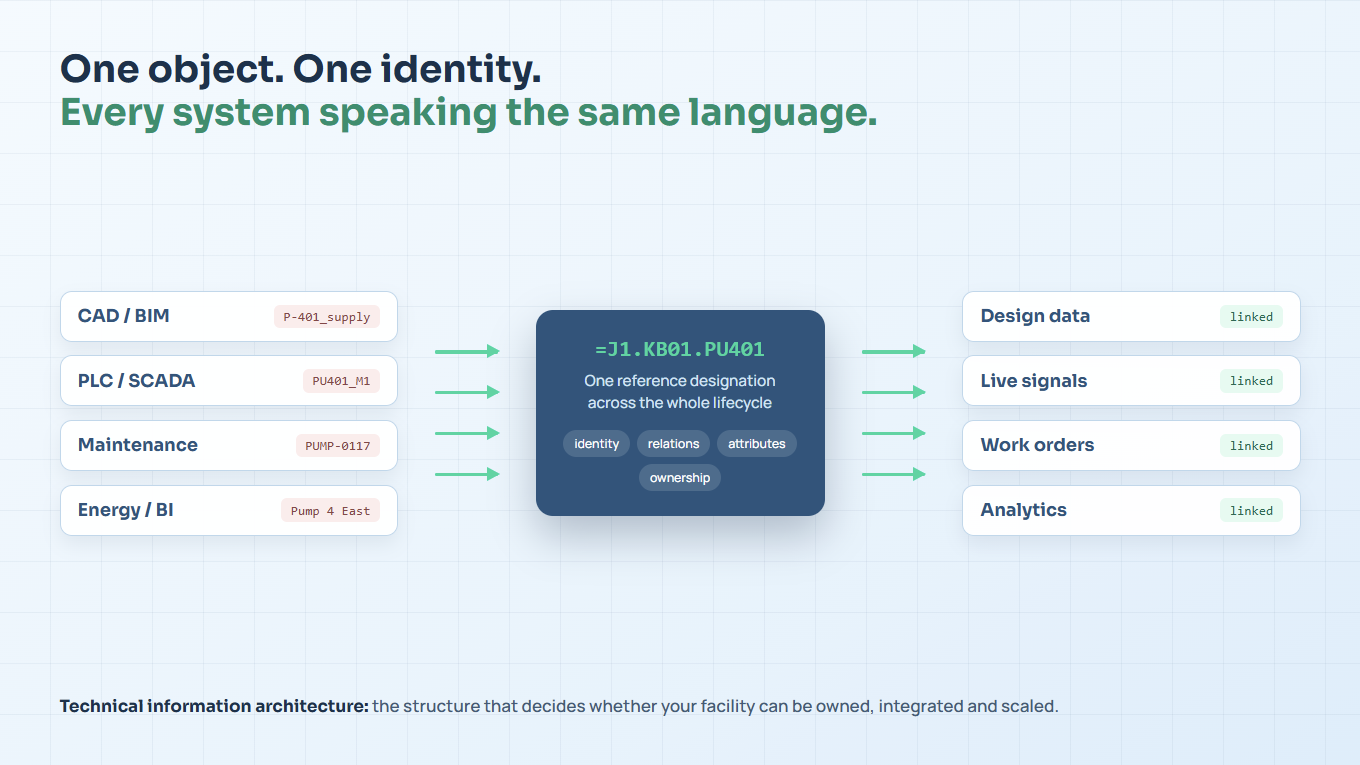
But in many projects, this information is not treated as a system in itself. Each supplier, discipline and platform structures information in its own way. Equipment has one name in the design model, another in the PLC, another in SCADA, another in the documentation, and a separate identity in the maintenance system. Signals are delivered without clear meaning. Requirements are written without traceability. Data is moved between systems without a defined owner.
Most projects already produce large amounts of data. The problem is that the data is often fragmented, inconsistent and difficult to trust. The result is technical debt built into the facility before it is even in operation.
The Same Pump, Eight Identities
Within a single project, one pump may exist as a physical object, a drawing symbol, a BIM object, a PLC tag, an OPC UA node, a SCADA object, a maintenance asset and a line in a supplier document. If these representations are not connected, the owner has no coherent understanding of their own asset.
The same pattern repeats for requirements, signals, alarms, documents, interfaces and handover data. When information is not structured, the facility becomes harder to own.
Data mapping is the work of saying: this is the same real-world object, expressed in different systems and data models.
Data Mapping Is the Activity, Not the Whole Solution
Data mapping is the practical work of connecting information between systems: a supplier tag to an OPC UA node, a BIM object to an asset record, a process signal to a historian tag. It is necessary, but not sufficient.
To create long-term control, the owner also needs information modelling, semantic modelling, master data ownership, data governance and clear integration principles. Together, these disciplines define:
- what the information means
- how it should be structured
- which system owns it
- how it moves between systems
- who is responsible for maintaining it
- how it can be verified and reused over time
This is technical information architecture. Standards such as IEC 81346 provide the structural foundation: stable identities for objects, systems and functions that hold throughout the lifecycle.
Why It Matters for Asset Owners
Without a clear information architecture, the owner becomes dependent on suppliers, individuals and undocumented project logic. Future changes become slower, integrations more expensive and operations harder to manage.
With a clear information architecture, the owner can create traceability between systems, assets, requirements, documents and operational data. This makes it easier to commission the facility, maintain it, integrate new systems, analyse performance and continue developing the facility over time.
Technical information architecture is therefore not an IT issue. It is a lifecycle ownership issue.
HubMind’s Role
HubMind helps asset owners create structure where technical complexity would otherwise grow. We work across automation, IT/OT, BIM, asset management, requirements, supplier data and system integration.
Our role is to connect technical objects, signals, requirements, documents, responsibilities and systems into a coherent information structure that can be used throughout the facility lifecycle. The result is better traceability, clearer ownership, stronger integration and a facility that is easier to understand, operate and develop over time.
Need a structure your facility can actually be owned through?
HubMind helps asset owners align information modelling, master data ownership and governance so systems can integrate and operations can scale.
Continue reading

The Complete Object: Who Owns Which Truth?
A practical owner-side guide to technical information authority: who contributes, governs and assures each part of a complete technical object.
Read article
Brick: The Semantic Interface
Turn a Brick graph into a governed semantic interface using SPARQL discovery, external data references, SHACL validation, versioning, provenance and acceptance tests.
Read articleBrick: One Object, a Graph of Context
Build a useful Brick subgraph around AHU-3 using classes, instances, composition, topology, location, points, controls and governed graph boundaries.
Read article
Leave a Reply